Thanks to the newest ETFs listing on SGX in October, local investors can now get several exposures that previously required us to venture overseas.
For years, Singapore investors buying the S&P 500 had to choose between convenience, lower fees and better tax efficiency — we rarely got all three at once. With Xtrackers’ Irish-domiciled S&P 500 UCITS ETF now coming to SGX, that trade-off has just become smaller. investors can get the lowest fee of 0.03% p.a., trade in SGD during Singapore market hours and at the same time, benefit from the Irish fund structure that eliminates US estate tax risks and reduces U.S. dividend withholding taxes from 30% to 15%.
So, is this now the cheapest way for a Singapore investor to buy the S&P 500?
Let’s look at the numbers.
Background: Buying the S&P 500 used to involve choosing your trade-offs
If you started investing before 2026, there were three common routes Singapore investors used to buy the S&P 500:
- buy SPY or VOO on a U.S. exchange;
- buy CSPX, the Irish-domiciled UCITS ETF commonly traded on the London Stock Exchange; or
- buy S27 on SGX.
Unfortunately, each of them had their respective trade-offs, and choosing one benefit meant sacrificing another:
| SPY / VOO | CSPX | S27 | |
| Domiciled in | US | Ireland | US |
| Can buy with SGD? | No. | No. | No. |
| Incurs custodian fee? | Yes | Yes | No |
| US dividend withholding tax | 30% | 15% | 30% (deducted at fund level) |
| US estate tax | 40% | No. | 40% |
| Trading hours | US market hours | Euronext market hours (3 PM – 12 AM SGT) | SGX market hours (9 AM – 5 PM SGT) |
| Expense ratio | 0.09% (SPY) 0.03% (VOO) | 0.07% | 0.09% |
| Can I do options trading? | Yes (SPY is more liquid and has greater options depth than VOO) | No | No |
SPY and S27 are in fact the same U.S.-domiciled State Street SPDR S&P 500 ETF Trust but is simply traded on different exchanges.
For those wanting to avoid the high US tax risks, buying Irish-domiciled funds make a difference because for a non-US investor without an applicable US. tax treaty, Dividends payable from the US are generally subject to 30% withholding tax, whereas an Irish fund benefits from the lower US-Ireland treaty rate of 15% instead.
That’s the reason why CSPX became increasingly popular with Singapore investors in recent years. But it introduced another problem: access.
You needed a brokerage that offered access to the London Stock Market, which isn’t available on the majority of mainstream brokerages like moomoo. You also needed to manually convert your SGD into foreign currency, and maintain a separate LSE account just to own these funds.
The good news is, from October 2026 onwards, these trade-offs will become a thing of the past.
How to buy the S&P 500 in Singapore now
SGX is now listing 4 Xtrackers UCITS ETFs offered by DWS, which is the 3rd largest ETF provider in Europe and owned by Deutsche Bank.
One of them is the Xtrackers S&P 500 UCITS ETF, which will soon trade on SGX under the ticker XUS. This ETF is domiciled in Ireland, and charges the lowest total expense ratio among all the existing S&P 500 ETFs i.e. just 0.03% p.a.^
On a $100,000 portfolio, that works out to approximately:
- XUS: $30 a year
- CSPX: $70 a year
- SPY/S27: $94.50 a year
When similar ETFs are tracking essentially the same index, every recurring cost we can remove stays in our portfolios and gets to compound instead. On a bigger $1 million portfolio, that changes to become:
- XUS: $300 a year
- CSPX: $700 a year
- SPY/S27: $945 a year
I don’t know about you, but saving $645 every year sounds like a better option to me.
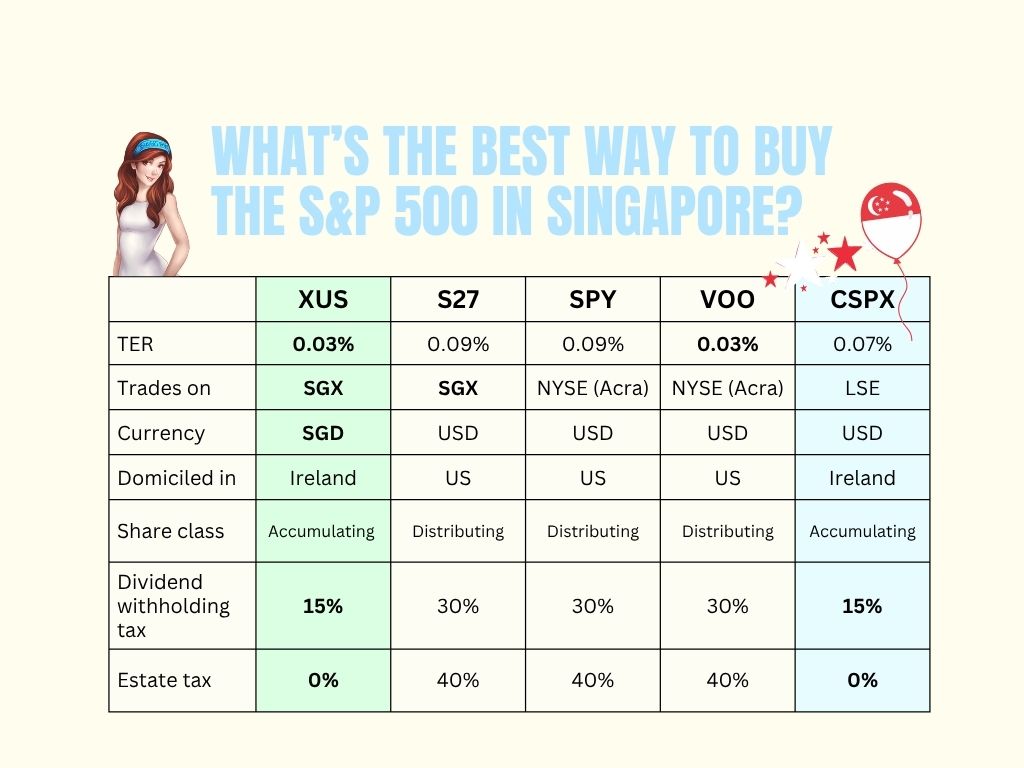
| XUS | S27 | SPY | VOO | CSPX | |
|---|---|---|---|---|---|
| Expense ratio | 0.03% | 0.09% | 0.09% | 0.03% | 0.07% |
| Trades on | SGX | SGX | NYSE (Acra) | NYSE (Acra) | LSE |
| Currency | SGD | USD | USD | USD | USD |
| Domiciled in | Ireland | US | US | US | Ireland |
| Share class | Accumulating | Distributing | Distributing | Distributing | Accumulating |
| US dividend withholding tax | 15% (at fund level) | 30% | 30% | 30% | 15% (at fund level) |
| US estate tax | 0% | 40% | 40% | 40% | 0% |
| Trading hours | SGX market hours (9 AM – 5 PM SGT) | SGX market hours (9 AM – 5 PM SGT) | US market hours | US market hours | Euronext market hours (3 PM – 12 AM SGT) |
Aside from lower fees, XUS comes with 2 other benefits: lower tax rates and being able to trade directly in SGD without having to manually convert to a different currency first.
Being an Irish-domiciled fund with the UCITS tax structure means we don’t have to worry about potentially losing up to 40% of our fund value in estate tax. At the same time, the ETF pays only 15% tax on its dividends thanks to the beneficial US-Ireland tax treaty. Since XUS is an accumulating share class, this means dividends are reinvested within the fund rather than being paid out to investors, so you won’t see any withholding taxes on your brokerage statement (although the 15% will still continue to be taxed at the fund level).
We can also sidestep the US estate-tax issue associated with directly owning US-domiciled funds or stocks. For any investor who are non-US citizens, the IRS currently levies up to 40% estate tax. This is why traditionally holding US-domiciled stocks or ETFs such as SPY or VOO can quickly create estate-planning considerations for Singapore investors once portfolios become bigger and more sizeable.
What’s more, being able to buy XUS in SGD means we don’t first have to manually convert SGD into USD before we trade. That makes it more convenient. What doesn’t change is that the fund still owns US stocks whose values are predominantly exposed to the USD, which means our eventual SGD return can therefore still be affected by movements in USD/SGD.
If the USD continues to weaken against SGD, then our SGD-denominated investment return can still be dragged down even if the S&P 500 itself rises in USD terms. The reverse can happen when USD strengthens against SGD.
The 4 new Xtrackers ETFs coming to SGX
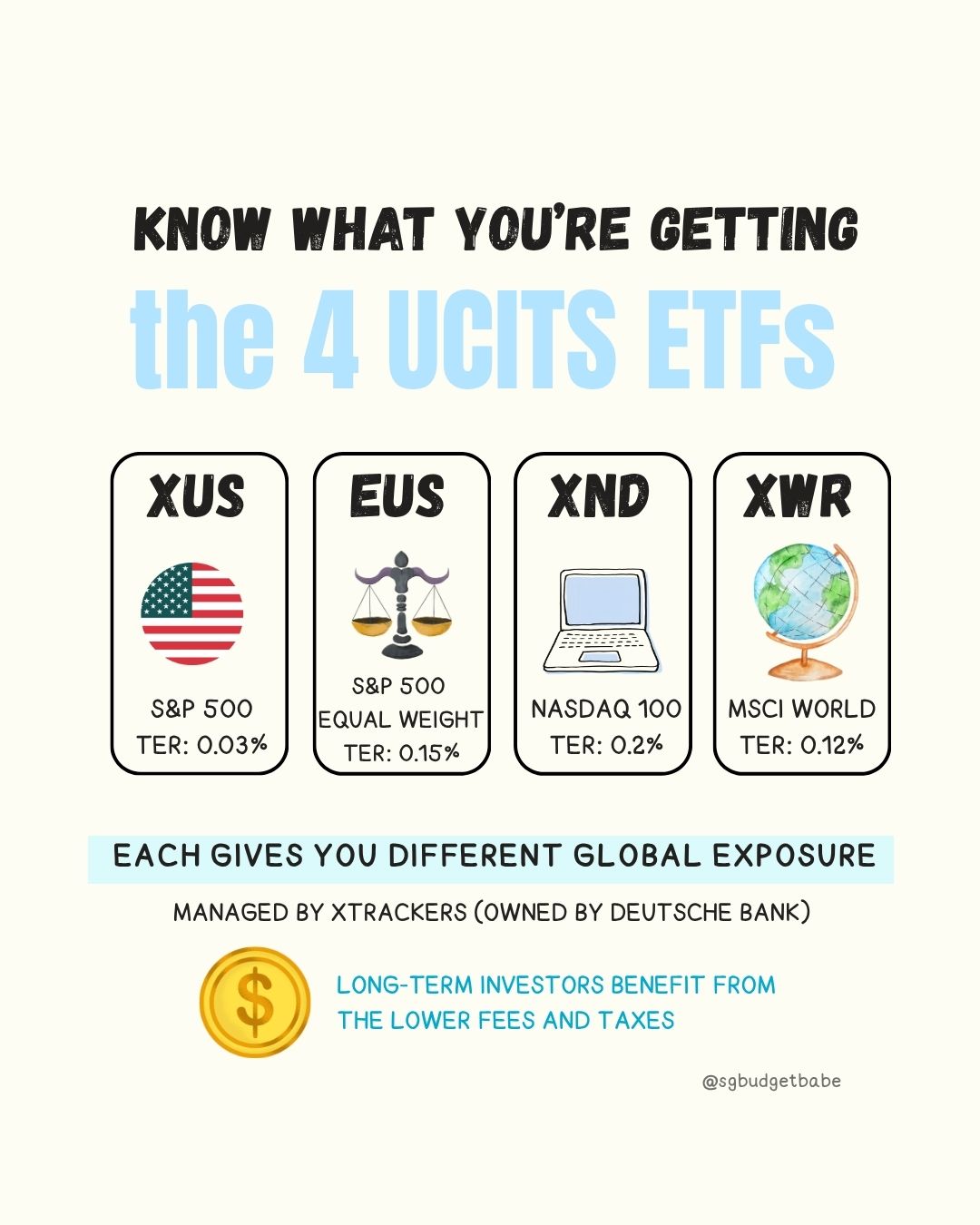
The S&P 500 ETF is only one of four being introduced. Its listing comes alongside 3 other new UCITS ETFs that cover the Nasdaq 100, MSCI World and an equal-weight S&P 500 strategy.
Each of these fill long-standing gaps in Singapore’s local ETF universe, and is a first on SGX available in SGD:
| Ticker | Name of ETF | Exposure | Total Expense Ratio |
| XUS | Xtrackers S&P 500 UCITS ETF | The 500 largest US companies | 0.03% |
| EUS | Xtrackers S&P 500 Equal Weight UCITS ETF | Same S&P 500 universe but equal weighted | 0.15% |
| XND | Xtrackers Nasdaq 100 UCITS ETF | 100 largest non-financial companies listed on Nasdaq | 0.20% |
| XWR | Xtrackers MSCI World UCITS ETF | Developed country markets globally | 0.12% |
While these 4 ETFs are new on the Singapore stock exchange, these aren’t brand-new investment strategies being created from scratch simply for Singapore. They are share classes/listings linked to existing, established European UCITS funds that have already been available overseas prior to this.
Comparing the S&P 500, Nasdaq-100, MSCI World or equal-weight S&P 500?
You don’t have to. Each ETF solves a different problem and provides varying levels of exposure. You should be looking at the investment objective you wish to achieve, and then match the best ETF that will help you to meet that. In this case, you can either get all 4 ETFs, a combination of them, or even none at all.
- XUS: For investors looking at broad exposure to large U.S. companies, XUS can be compared with other ETFs such as SPY, VOO, CSPX and S27 that also track the S&P 500.
- EUS: For those getting concerned about overconcentration within the S&P 500, EUS tracks an equal-weight version of the index instead, which periodically rebalances constituents towards equal weights. This reduces the influence of the largest companies and provides relatively greater exposure to smaller constituents compared with the conventional market-cap-weighted S&P 500. However, one risk that this could underperform the conventional S&P 500 for long periods when mega-cap stocks lead the market.
- XND: This tracks the Nasdaq-100, hence providing greater exposure to technology and growth-oriented companies compared with the S&P 500 and excludes financial companies. This can work wonderfully when those sectors outperform, but it can also hurt when they don’t.
- XWR: Finally, XWR tracks the MSCI World index, and although it still has significant exposure to the US market, it gives a broader geographical spread with exposure to 23 developed countries in one ETF.
Q: If I already have CSPX, should I sell and switch to XUS?

Both CSPX and XUS are Irish-domiciled and enjoy the same tax benefits. Their main difference lies in the currency each is traded in, and the convenience of access.

Access and convenience means different things to everyone, so you have to decide what you can tolerate, and which causes you too much friction to continue putting up with. If you’re already comfortable with your existing CSPX holdings, then you should decide if it makes sense to switch in order to save on a 0.04% fee difference each year from here.

As for me, I’ve never bought CSPX because the brokerages I use most often do not offer it, and I didn’t like that I couldn’t trade options on it. That’s why SPY was a better pick for me (despite having higher fees than VOO) as it had higher liquidity, allowing me to trade options and earn premiums on my existing position anytime I wanted to.

But if I had CSPX today, I would sell it and switch to XUS because I value the convenience of having everything in the same few brokerages.
I’d watch the liquidity and bid-ask spreads.
As an investor, I will always check the bid-ask spread before I place an order and this is where your order type matters; use limit orders to control the difference rather than simply filling at the best market price.
As the 4 Xtracker ETFs are still new, we don’t know how their liquidity and bid-ask spreads will be just yet. If these ETFs do not take off or gain traction, then it is entirely possible that it’ll be illiquid (making it harder to trade) and have higher bid-ask spreads on the market. A lower 0.03% TER won’t be that impressive anymore if investors repeatedly lose far more than that by paying for unnecessarily wider spreads.
Do also note that these SGX-listed funds will have the same performance as their European counterparts as they are the exact same fund (dual/multi-listed), rather than being a brand new fund created just for listing on SGX. Each fund shares the same AUM pool, NAV and underlying holdings as its European counterpart.
One more downside? For now, these UCITS ETFs are currently ineligible for regular shares savings (RSP) plans at this moment. You will need to manually buy them each time, but this could change shortly as the ETFs gain traction.
You can buy the 4 Xtracker UCITS ETFs with SRS
The good news is, for long-term investors who wish to buy these ETFs using your SRS, you’ll be able to do so on moomoo from October 2026 onwards after they list on SGX! I’ll personally be using my own SRS funds to buy these funds in due time.
These ETFs will be listed on SGX on 13 October 2026, and for the next few days, you can avoid the bid-ask spreads by getting in exclusively during their launch on moomoo.
Subscribing for these ETFs takes place from now until 30 September 2026 (12pm SGT) for XWR, and closes 1 October 2026 (12pm SGT) for XUS / XND / EUS.
From 13 October 2026, the ETFs will start trading officially on SGX, where you can then buy them through any of your SGX brokerages.
Early subscriptions can only be done on moomoo; you won’t be able to subscribe anywhere else. During the subscription window, you save two things:
- 0%* subscription fee* — moomoo is not charging any fees during the initial listing period. After the public listing, buying on the secondary market means you will have to pay a broker commission each time.
- Price locked near NAV — there are no wide bid-ask spreads to worry about during the subscription stage, so this helps you avoid any market-maker spread on the open market.
If you’re concerned about the ETFs track record, you don’t have to worry about these ETFs being new since they have already been running for 12 years in Europe, with a combined AUM of USD 51.1 billion. The ETF’s own price movement (following the underlying index) applies equally regardless of when you enter.
Both savings are gone once the ETFs list. This is the first time SGX has listed Nasdaq 100 + MSCI World + Equal Weight S&P 500 UCITS ETFs at the same time — all available exclusively via moomoo.
If you wish to subscribe during this initial offering period, follow these steps:
- Open a moomoo account here. For existing moomoo users, simply deposit new funds by keying in “Special deposit” in-app and type my referral code SGBB1.
- Tap on Markets → SG → IPO
- Select the ETF you want, and tap “Subscribe”. Confirm your subscription amount (minimum S$1,000) and then submit.
Your subscription will be filled in full with no balloting. If you change your mind or wish to increase/reduce your exposure, you can amend or cancel your order anytime before the initial offering period closes.
For new users, get S$80* trading cash coupons and S$220* NVIDIA shares, exclusive to SGBB readers, when you open your moomoo account and deposit at least S$10,000.
TLDR Conclusion
SGX will soon be welcoming 4 new ETFs that fill current long-standing gaps for Singapore investors. Aside from their low, competitive fees (with some ETFs being the cheapest among competitors), you’ll also be able to trade them in SGD and during the usual Singapore market hours instead of staying up late for US/Europe market hours.
All of the 4 Xtracker ETFs are Irish-domiciled, physically replicated and have an accumulating share class. This is a much better structure because aside from its tax benefits, physical replication carries the lowest structural risk, while an accumulating share class (with dividends automatically reinvested) makes it a better fit and provides substantial cost-savings over time for long-term investors.
This is great news for Singapore investors, as it means we now have better options available that allows us to trade in a more tax-efficient and convenient manner. What’s more, we’ll now be able to trade directly in SGD without having to manually convert to a different currency first, and the previous account maintenance fees and FX costs of a few hundred SGD/year on larger accounts will now be a thing of the past.
Disclosure: This article is brought to you in collaboration with moomoo Singapore.
Disclaimers: *Campaign T&Cs apply. Past performance is not indicative of future performance. The prospectus for the Xtrackers S&P 500 UCITS ETF, Xtrackers S&P 500 Equal Weight UCITS ETF, Xtrackers MSCI World UCITS ETF and Xtrackers NASDAQ 100 UCITS ETF (collectively, the “Funds”) is available at Xtrackers.com. Investors should read the prospectus before deciding whether to subscribe for or purchase shares in the Funds. The value of the shares in the Funds and the income accruing to the shares, if any, may fall or rise.The responsible person for the Funds is Xtrackers (IE) plc. The Xtrackers S&P 500 UCITS ETF, Xtrackers S&P 500 Equal Weight UCITS ETF, Xtrackers MSCI World UCITS ETF and Xtrackers NASDAQ 100 UCITS ETF seek to track, before fees and expenses, the performance of the S&P 500 Index, S&P 500® Equal Weight Index, MSCI Total Return Net World Index and NASDAQ-100 Index, respectively. Investors generally cannot redeem their shares directly with the Funds and may only do so under certain specified circumstances. Investors may buy or sell the Singapore Shares on the SGX-ST. The listing of the Singapore Shares on the SGX-ST does not guarantee a liquid market for the shares.

^Fees accurate as of 18 September 2026. TER may change at the discretion of the fund managers.

This article is a sponsored advertorial written in collaboration with Moomoo Singapore. SG Budget Babe is not licensed to provide financial advisory services in Singapore. This content is for informational purposes only, does not constitute financial advice, and reflects the author’s independent opinion. Please conduct your own research and invest according to your personal risk tolerance. This advertisement has not been reviewed by the Monetary Authority of Singapore.