I studied how our system compares with the US, Hong Kong, Australia, the UK and China, so you don’t have to. Here’s what every Singapore investor should know before choosing between CDP and broker custody.
What is a CDP account?
A CDP securities account is an account operated by The Central Depository, a wholly owned subsidiary of the Singapore Exchange (SGX), which established the CDP in 1987 to provide clearing, settlement and safekeeping services for securities traded on the Singapore financial markets.
This allowed direct retail investors to hold eligible Singapore-listed shares in an individual CDP account under their own name, and their investments were not locked inside the brokerage platform where they first bought them. You could buy shares using one CDP-linked broker, hold them centrally in CDP, and then sell them later through another broker.
But CDP ownership was only limited to securities listed and traded on SGX i.e. stocks, ETFs, bonds, government bills, etc.
For foreign shares, these are all held through broker custody or nominee structures. This meant that many investors were juggling between using CDP for their Singapore holdings and a custodian structure for their overseas assets.
That was then. The investing landscape has changed dramatically since.
Today, many of us use low-cost online brokerages to buy Singapore, US, or other overseas stocks on the same mobile app. We are used to zero commissions, low platform fees, fractional shares and enhanced datasets that weren’t previously accessible to us. And in overseas markets, this has already the norm for years.
That is partly why SGX RegCo moved to facilitate wider adoption of broker custody accounts. In their review, SGX said roughly two-thirds of retail accounts in CDP were individually segregated direct accounts, while the remaining one-third were broker custody accounts. In recent years, the latter number has been rising rapidly with new account openings.
What is a custodian account?
With a custodian account, your broker—or a custodian appointed by your broker—holds the securities on your behalf. At the depository or company-register level, the broker, nominee or custodian may appear as the registered shareholder. Your broker’s internal records will then show that you are the underlying beneficial owner.
Investors still enjoy the usual benefits as a shareholder, but the main difference is that communications and shareholder instructions generally flows through the custodian e.g. AGM announcements, rights subscriptions or voting instructions.
The exact process differs across brokers. Some make these actions fairly easy, while others impose fees, deadlines or limitations. And if the investor turned off notification settings for their brokerage app on their phone, then they might miss it entirely.
Wait, does this mean my overseas shares are not in my name?
When you buy a US-listed stock through a brokerage, the shares are typically held by The Depository Trust Company (DTC) nominee, Cede & Co., which is shown as the registered owner on the issuer’s records. Your broker then records you as the beneficial owner in its own books.
This might sound alarming when you first hear it. After all, who wants to discover that the Apple shares they proudly bought are technically registered under a company called Cede & Co.?
In fact, this nominee custody model is a normal part of how most major global securities markets operate.
| Market | Main system | Typical holding structure | Direct ownership? | Key point |
|---|
| Singapore | CDP | Direct CDP account or broker custody | Yes | Central account; not tied to one broker |
| US | DTC | Broker “street name” | Uncommon | Investor is beneficial owner |
| Hong Kong | CCASS | Broker or custodian nominee | Uncommon | HKSCC Nominees is registered holder |
| Australia | CHESS | CHESS-sponsored broker account | Yes | Investor identified by a ASX-issued Holder Identification Number (HIN) |
| UK | CREST | Broker nominee account | Uncommon | Investor is beneficial owner |
| China | ChinaClear | Direct domestic account or nominee structure | Yes (only for domestic PRC accounts) | Stock Connect uses nominee custody |
Hong Kong uses a similar nominee structure for shares deposited into the Central Clearing and Settlement System (CCASS). HKSCC Nominees Limited generally holds legal title as the registered shareholder, while the participants or their customers hold the beneficial interest.
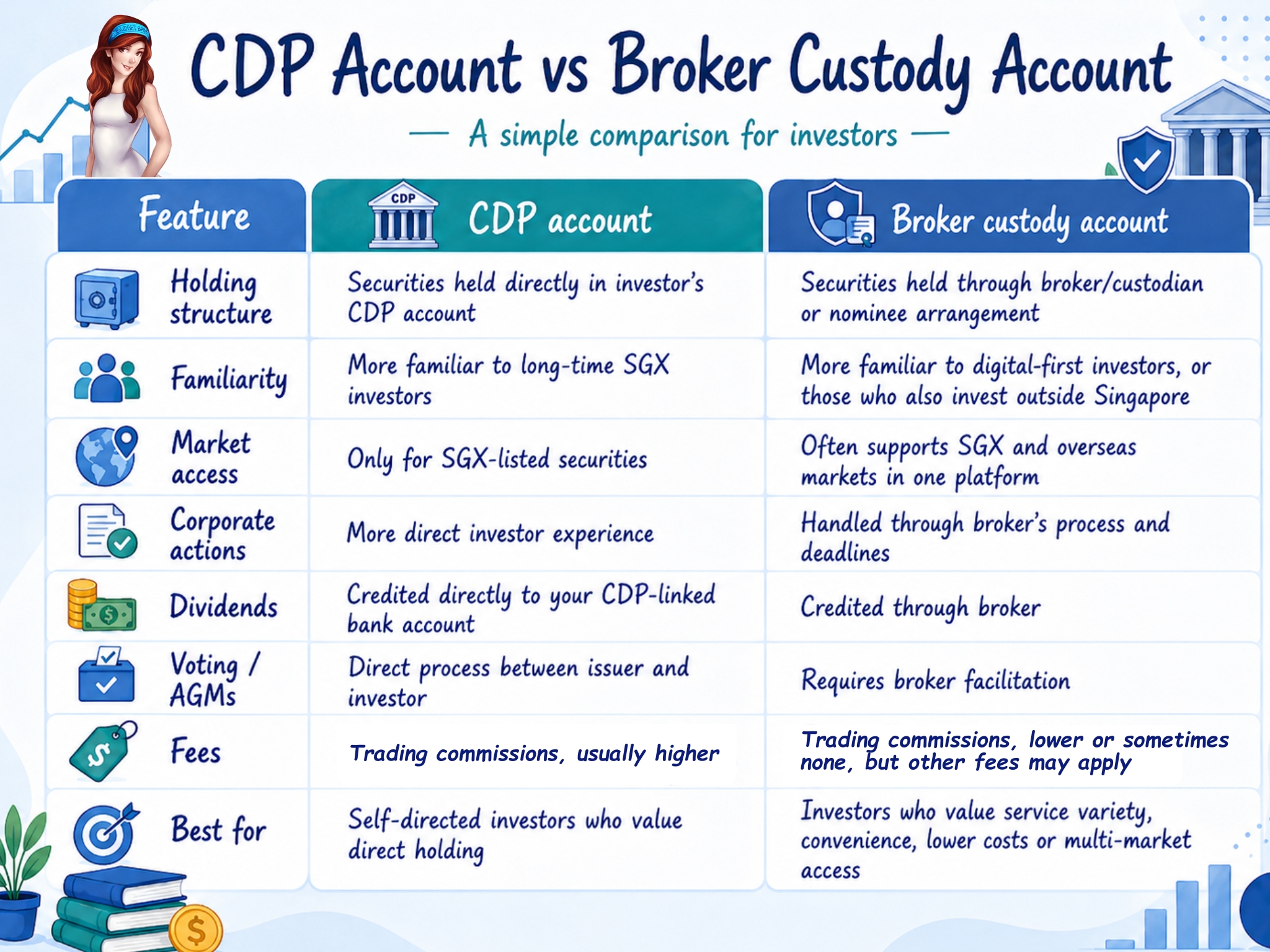
CDP vs custody accounts: What’s the difference?
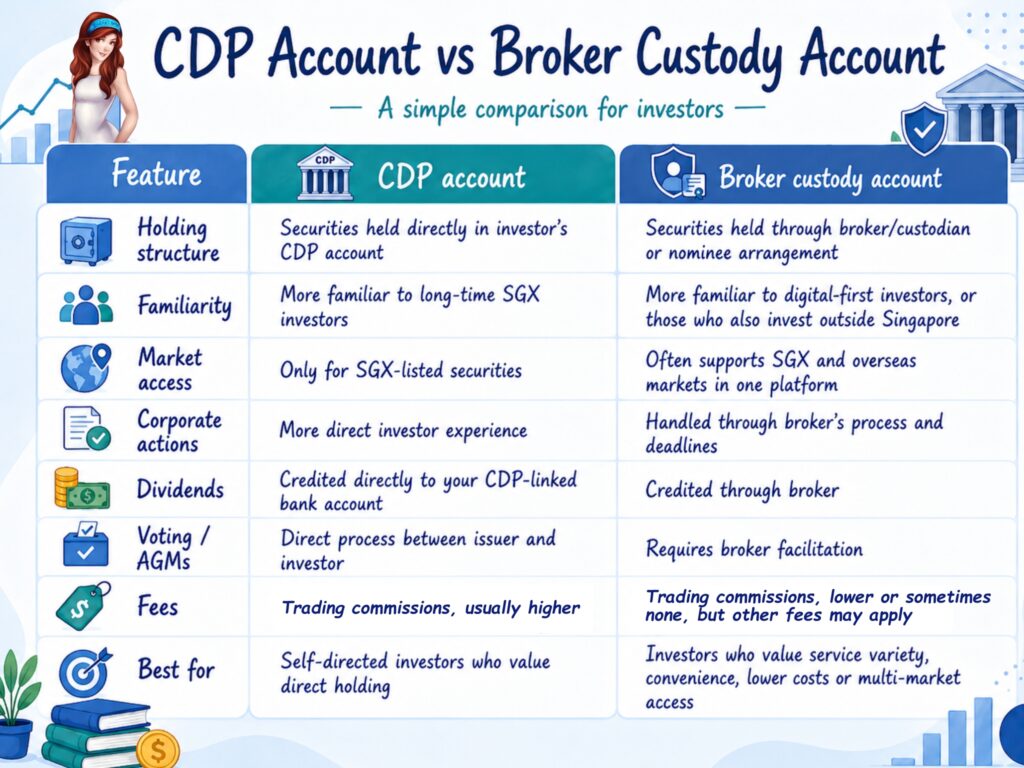
The bigger question here is whether the broker properly safeguards client assets, maintains accurate records and allows you to exercise your rights. And as an investor, you ought to understand these things instead of waiting until something happens.
What happens next for CDP account holders?
To be clear, this does not mean CDP is disappearing. SGX hasn’t said anything about closing it down just yet.
But as online brokerages and low (to zero) commissions become the norm, supporting trades through a CDP-direct ownership model no longer makes as much sense as it did before (in an era of higher fees payable through bank brokerages).
The broader direction here is about
- Giving broker custody a larger role,
- Improving shareholder protections under the custodian model, and
- Educating investors about the differences between direct and beneficial ownership.
The strongest argument for owning shares in your CDP right now is that you don’t have to be tied down to one broker, and you receive everything directly in your bank or mailbox – instead of having a third-party (your brokerage) manage it for you.
After all, if you are buying four times a year and holding for decades, the difference in brokerage commission then becomes less important than it is to an active trader who is trying to cut down on their 5-digit brokerage bill (true story – just ask my friend Jiax!).
Convenience and a unified dashboard
Keeping Singapore shares in CDP while all your foreign shares sits with a broker can result in a fragmented portfolio, which becomes troublesome to manage rather than just one unified dashboard.
SGX has specifically identified fractional trading and portfolio-management services as potential benefits of wider broker custody adoption. That’s because a brokerage offering fractional trading may allow you to purchase one-third of a share, while the traditional CDP arrangement is not designed around that type of allocation.
Fractional investing can be especially useful for beginners, dollar-cost averaging, and building diversified portfolios with strict percentage allocations to manage your position exposure.
Owning your shares through a nominee arrangement does not necessarily mean it is unsafe. After all, SGX imposes strict rules requiring trading members to keep customer assets separate from their own assets, and prohibit the commingling of customer assets with the broker’s assets.
If your broker fails, your properly segregated shares should not simply become available to the broker’s creditors. But there may still be administrative delays while records are checked, reconciled and transferred. Under CDP ownership, none of these would matter.
Case Study: ProsperUs, owned by CGS International, was formally shut down in late 2025. Users with existing shareholdings had to either liquidate (sell to cash) or transfer their positions to other brokerages such as CGS International or Interactive Brokers.
In short, having CDP ownership gives investors direct management and independence, while custody accounts offer lower costs, more advanced tools and greater convenience by consolidating holdings across multiple markets in one place.
You can’t have your cake and eat it too (fees for a CDP ownership arrangement will never be as low as online broker custody) – so you have to choose one.
TLDR: Conclusion
When CDP was created in 1987, investing was largely domestic, brokerage fees were high and there were no mobile-first brokerage apps giving retail investors instant access to global markets.
Today, the average investor can buy shares across several countries from just one screen. That calls for our investment infrastructure to evolve too.
Personally, I see a role for both.
My dividend portfolio consists of mostly Singapore stocks that were built over the last decade, having started before the low-cost online brokerages entered the scene. For this portfolio, I’ve gotten used to receiving AGM notices and letters in my mailbox as well as receiving dividends directly in my bank, so I’m too lazy to switch this out.
But for any new Singapore stocks that I didn’t buy for my dividend portfolio in the last 2 years, I’ve already switched to buying through nominee custody arrangements – that’s why my transaction fees and costs have since dropped to a fraction of what I used to pay.
As for my overseas stock holdings, which make up 75% – 80% of my portfolio?
They’ve always been owned under brokerage custody anyway.
With love,
Budget Babe