
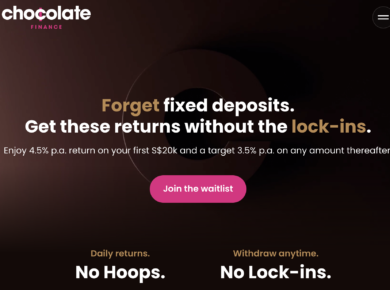
It has been 3 years since I started putting my money in Chocolate Finance, as it offered Singaporeans a new model of investing our spare cash to get returns higher than fixed deposits and without any lock-ins.
If you’ve been following my coverage since I first grilled their CEO Walter de Oude over coffee back in 2023, you’ll know I’ve never been one to just take a company’s word for it and call it a day. And if there was ever a year that tested whether Chocolate Finance deserved the trust Singaporeans placed in it, 2025 was absolutely that year.
So here’s my honest 2026 update: the rates have come down – as has the rest of the market, it went through a stressful episode in March 2025 that sent thousands of people into a panic, and yet – I’m still in.
It is not only satisfying to see my daily returns trickle in, but also a significant raise from how much my funds were getting from where they were kept previously (in my bank account):


Let me walk you through everything so you can decide for yourself whether Chocolate Finance deserves a spot in your personal finance strategy this year.
What March 2025 showed
Some people lost faith in Chocolate Finance after its March 2025 incident last year. However, the way I see it, what that showed was:
– the actual lack of knowledge by most customers, as well as
– the resilience of the company’s business model.
When I first came to know about Chocolate Finance during their launch in 2023, I’ve repeatedly said that they’re not a bank. But this fact seemed to have been lost on many people – perhaps they signed up simply because they were hungry for the juicy returns, and failed to do their due diligence (such as reading this article first).
When a couple of YouTube videos went viral and caused fear that a “bank run” was about to happen, thousands of customers opened the app and requested to pull their funds all at once.
Over S$500 million in withdrawals were processed in that single week, and this was just in Singapore’s market alone.
To be fair, I’m not sure if even the larger finance institutions could have supported the same. After all, just a few weeks ago, even the world’s largest asset manager with more than $10 trillion in assets i.e. BlackRock blocked nearly half of its investors who requested withdrawals from its $26 billion private credit fund from getting their money back. Not because the fund had collapsed, but simply because too many people wanted out at the same time, and the fund didn’t have the liquidity to pay them all.
Now, here’s the part that I think got lost in all the noise:
Our money was never at risk.
When Chocolate Finance suspended instant withdrawals on 10 March 2025, citing “high demand”, what they really meant was that the sheer amount of withdrawals exceeded their ability to repay (by selling funds) fast enough.
The panic got so bad that MAS had to step in on 12 March to confirm Chocolate Finance had fully met all requirements for customer asset segregation.
Your funds – mine included – were held in ringfenced, independent custody accounts with custodians like HSBC and State Street the entire time. This is fundamentally different from a bank run, where depositors’ money actually sits on the bank’s balance sheet and can be at risk if the institution fails.
That’s exactly why I didn’t see the need to pull my funds. If you understand how the underlying mechanism works, you’d know that the panic was unwarranted.
The instant withdrawal pause was exactly what it was described as: a suspension of a promotional liquidity programme, not evidence that the underlying funds were in trouble.
And the standard fund redemption timeline of 3-10 business days that kicked in later? That’s actually the norm for this type of investment product.
Most people just hadn’t read the T&Cs closely enough to know that instant withdrawals were never a guaranteed feature – they were simply a perk offered by Chocolate Finance.
Unfortunately, this is a perk that we can no longer get back after MAS said so, in light of what happened.
“Instant withdrawals are unlikely to be possible again in Singapore. However, we currently process 90% of withdrawal requests within 30 hours, and we’re working to get it down to 90% on the same day soon.”
– Walter de Oude, founder and CEO of Chocolate Finance
So what does Chocolate Finance look like today?
Having survived such a huge crisis, I think it is fair to say that Chocolate Finance has grown even stronger by now.
With over 100,000 customers and $1.1 billion in assets under management, Chocolate Finance has not only delivered on its promise to give us returns higher than fixed deposits and without any lock-ins, but they’ve also launched newer options within their ecosystem.
Think a Visa debit card – one that I’ve been using to earn Max miles on all of my public transport fares and for any purchases below S$5 (because my banks only award me miles in S$5 spending blocks).
There’s also a USD account, which now allows direct deposit vs. conversion via your SGD Chocolate Finance account. This made it attractive for me to transfer my USD funds over, since they were just sitting in my multi-currency bank account as emergency funds earning minimal interest anyway.
And earlier this year, they even expanded to Hong Kong!


Of course, in terms of their rates, these have dropped since 2023 – and that’s not surprising if you’ve been paying attention to the broader interest rate environment.
When I wrote my previous review, Chocolate Finance was offering 4.2% p.a. on your first S$20,000. Today, their rates look like this:
| SGD Account | USD Account | |
| First S$20k | 2% p.a. | 4.1% p.a. |
| Next S$30k | 1.8% p.a. | 3.8% p.a. |
| Above S$50k | Up to 1.8% p.a. | Up to 3.8% p.a. |
Now, before you roll your eyes at the SGD rates, you’ll need to remember what happened to the broader interest rate environment during this same period:
– Banks have been slashing their interest rates on savings accounts.
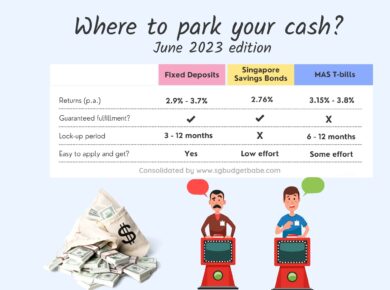
– Fixed deposit rates at local banks have slipped to around 1.6% p.a.
– The latest Singapore Savings Bonds issue is offering a first-year yield of just 1.35%.
– MAS T-bill yields have steadily declined in the past few years.
In other words, rates have come down across the board because that’s essentially where the market has gone.
Chocolate Finance has always positioned itself to offer around 50 basis points above the best available 3-month fixed deposit rates, and that’s exactly what they’re still doing.
So yes, 2% p.a. on SGD is lower than it used to be. But compared to what else is out there right now for your spare cash with no lock-ins? By that measure, it is still competitive.
I had the pleasure of attending a media briefing hosted by Chocolate Finance to talk about their Hong Kong launch and upcoming changes, and learned that they hope to launch a new investment product later in 2026:
“Many investors want two things from their money: growth and income. That’s why we’re building a simple, set-and-forget investment product designed to deliver long-term returns alongside monthly dividend income.”
– Benjamin Tan, Chief Investment Officer
They’ve yet to release further information about this at the moment, so I’ll update when information becomes publicly available.

“Chocolate is not a bank. We compete with banks. Our job is to target returns in excess of bank fixed deposits so that we make money happier, and people’s lives richer. And we are doing a great job at that.
Next, we plan to compete with insurance companies because I think ILPs suck and they are a terrible long term savings solution. I should know!”
– Walter de Oude, March 2026
Unlike the banks, which generate returns by investing customer deposits mainly in mortgages and credit, Chocolate Finance is a managed account that primarily invests in short-duration fixed-income funds and money market funds, giving them greater flexibility to make your money work hard for you.
At this moment in 2026, the portfolio is currently made up of:
- Dimensional Short-Term Investment Grade Fixed Income SGD Fund (DSF)
- UOBAM United SGD Fund (USF)
- Fullerton Short Term interest rate SGD Fund (FST)
- LionGlobal Short Duration Bond SGD Fund (LGF)
- Amova Short Term Bond Fund (NST)
Compared to 2024, you can see how the portfolio has evolved to add more funds and spread out the liquidity risk while balancing returns.
And for those who wish to geek out over the fund documents before you invest (like I typically do), you can find them here.
As for DIY investors who might be tempted to buy the same funds directly yourself instead, the simple answer is that we can’t.
- That’s because Chocolate Finance invests in institutional share classes of the underlying funds i.e. the cheaper versions that aren’t available to regular retail investors. In other words, a DIY portfolio replicating the same funds (provided you successfully set it up) would already be paying higher fees for the same funds from the start.
- In addition, Chocolate Finance only earns its performance fees when they beat the stated return, whereas most DIY platforms charge fees upfront upon your transaction (or recurring portfolio fees annually) regardless of performance.
Given the funds and the level of returns being targeted, I don’t view the effort as worth my while to DIY – hence I’m happy to leave my mid-term cash in Chocolate Finance to be managed for me instead.
Why the Top-Up Programme sets it apart
What some people initially thought would be a short-lived promotional stint has continued to be extended, year after year.
The Top-Up Programme is significant, because it demonstrates Chocolate Finance’s commitment that if the underlying portfolio doesn’t hit the stated rates, they’ll make up the difference out of their own pocket.
Over the past few years, the Top-Up Programme hasn’t stopped even as Chocolate Finance grew, and this is currently still in place until 30 June 2026, or until total assets under management hit S$1.5 billion – whichever comes first.
This means you can consider the 2% p.a. SGD and 4.1% p.a. USD rates on your first S$20,000 to be the returns promised by Chocolate Finance – for now.
And if they fail to deliver? Well, that’s when you can decide whether you wish to pull out your cash and move it to where you can confidently get higher returns.
The USD account is where the real action is.
This is the part of the current offering that I find most compelling for 2026. While SGD rates have dropped as Singapore’s rate environment cools, USD rates are still meaningfully higher – 4.1% p.a. on your first US$20,000 and 3.8% p.a. on the next US$30,000.
So if you have USD savings, or if you’re comfortable holding some of your cash in USD (and understand the forex risk that comes with that), the USD account gives you these returns on up to US$50,000.
Combined with SGD returns on your first S$50,000, you’re looking at a total of roughly S$117,000+ that is being supported by Chocolate Finance for top-ups!
One thing worth noting: the USD has been weaker against the SGD lately, partly due to tariff uncertainty and recession fears in the US. That actually makes right now an interesting time to consider converting SGD to USD at the current cheaper rate and locking in the 4.1% p.a. – if the USD strengthens again, you’d benefit on both the interest and the exchange rate.
That said, forex is forex, and this is not something I’d recommend without thinking it through carefully based on your own financial situation.
Should you still put your money in Chocolate Finance?
Here’s my honest opinion.
The SGD rates today are less exciting than they were in 2023 or 2024 – that’s just the reality of where interest rates are right now. If you missed out because you were too sceptical before, that’s on you. Today, if you’re purely chasing yield, you’d need to accept that this environment is tougher for cash savers across the board.
But here’s what hasn’t changed:
- Chocolate Finance still beats most SGD cash alternatives for a no-lock-in, daily-returns product.
- Your money is still held in segregated custody with established institutions.
- The management team has been through a very public stress test and the money came back to everyone who wanted it. (Ironically, management confirmed that quite a number who panicked and withdrew their funds during the saga later put it back!)
- MAS stepped in to confirm the structure held.
- Chocolate Finance still has their license, and just gained regulatory approvals to offer the same in Hong Kong (license no. BSF252 by the Securities and Futures Commission of HK, if you were wondering).
For me, the March 2025 episode actually reinforced rather than weakened my view of Chocolate Finance, because when the dust settled, the structure did exactly what it was supposed to do.
The underlying funds were fine.
Customers got their money back.
MAS confirmed the ringfencing worked.
Most newer financial start-ups haven’t even been through such a stress test. So when one has been battle-tested, it deserves merit over the rest.
What I would say is this: treat it for what it is.
Chocolate Finance is not a bank savings account.
It is a managed cash investment account, where your funds get invested into short-term fixed income funds for higher returns.
While you’re not getting SDIC insurance because this is not a bank account, your funds with Chocolate Finance are held separately in custody i.e. HSBC, State Street, BNP Paribas, and Citibank.
This makes it appropriate for spare cash that you won’t need instantly at any moment. Don’t use it for your emergency fund if you might need S$30,000 overnight with absolutely zero notice.
But as a place to park your non-emergency cash and earn more than your savings account?
That still makes sense to me.
As always, do your own due diligence before making any financial decisions. If you found this useful, you can sign up using my referral link here.
Disclosure: This is a review and NOT a recommendation on whether to invest your funds in Chocolate Finance. All opinions are my own. This post is written in collaboration with Chocolate Finance to ensure accurate representation of its offerings. For new readers to this blog, I am not a licensed financial advisor – if you need personalised advice, please seek out your own MAS-licensed advisors.
Disclaimers: Chocolate Finance is a brand of Chocfin Pte Ltd and is regulated by the Monetary Authority of Singapore. The views and opinions expressed on this post are solely those of the original authors and contributors as of the date of this post and are subject to change based on market and other conditions. This is for information only and does not constitute an offer or solicitation to buy or sell any of the investments mentioned. Neither Chocfin Pte. Ltd. (“Chocfin”) nor any officer or employee of Chocfin accepts any liability whatsoever for any loss arising from any use of this post or its contents.

Please note that Chocfin does not guarantee the accuracy, relevance, timeliness, or completeness of the non Chocolate Finance information provided on this post. The inclusion of any links does not necessarily imply a recommendation or endorse the views expressed within them. Chocolate’s returns are currently supported by a promotional 'Top-Up Programme', valid during the Qualifying Period and subject to terms and conditions. Past performance is not indicative of future results. All investments involve risk, including the risk of losing all of the invested amount and may not be suitable for everyone. This advertisement has not been reviewed by the Monetary Authority of Singapore.




1 comment
Another risk: If any underlying fund fails, be prepared to have a portion of your funds locked up for quite a bit (or perhaps even lost, if someone defaults) as the fund gets liquidated.
Remote? Sure. Possible? Yes, particularly when markets are really stressed.
Comments are closed.