I’ve been using the Trust Freedom card for the past month and earning StockBack on my purchases. Here’s my user review of the card – whether it’s worth getting, what you should note, and how I’m using it.
As most of you would know by now, I put almost all of my spending through my credit cards. And while I have multiple cards, I’m all about optimising my card spending to get maximum rewards with the least hassle, rather than maximising every single reward but with too much trouble and caveats that I can never remember while I’m out with my kids.
Trust Bank recently launched Singapore’s first credit card to offer Stockback, where instead of earning cashback or miles on your spending, you can now earn fractional shares in US stocks and ETFs instead. This is an upgrade of their previous cashback-only card.
I find this choice of reward rather interesting, because it effectively turns something you’re already doing — spending — into an investing habit. I’ve been using the card myself both in Singapore and overseas, so here’s how Stockback actually works, the catch you should take note of, and whether I think it is worth using.
What is the Trust Freedom Card?
The Trust Freedom Card is a no-annual-fee credit card where you can choose how you want to be rewarded for your spending.
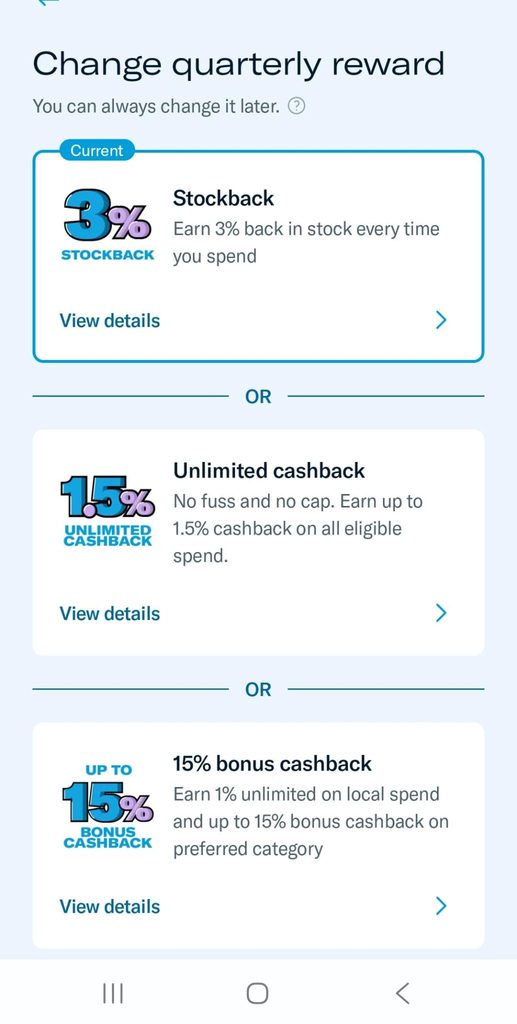
There is no minimum monthly spend required, and at 3% Stockback from now until December 2026, here’s what that looks like:
| Monthly Spend | 3% Stockback |
| S$500 | S$15 |
| S$1,000 | S$30 |
| S$2,000 | S$60 |
| S$5,000 | S$150 |
But unlike cashback, you won’t receive this money back as cash (which offsets your bill). Instead, it gets invested for you.
And that’s where things get interesting.
How does Stockback work?
When you select Stockback as your choice of reward mode, you’ll be prompted to choose a US stock or ETF from the list of 50 choices available in the Trust app. Savvier investors will appreciate that the list is not limited to some obscure investment product created specifically for the card either – these are actual blue-chip US companies and ETFs with high liquidity and get a lot of traction among investors.
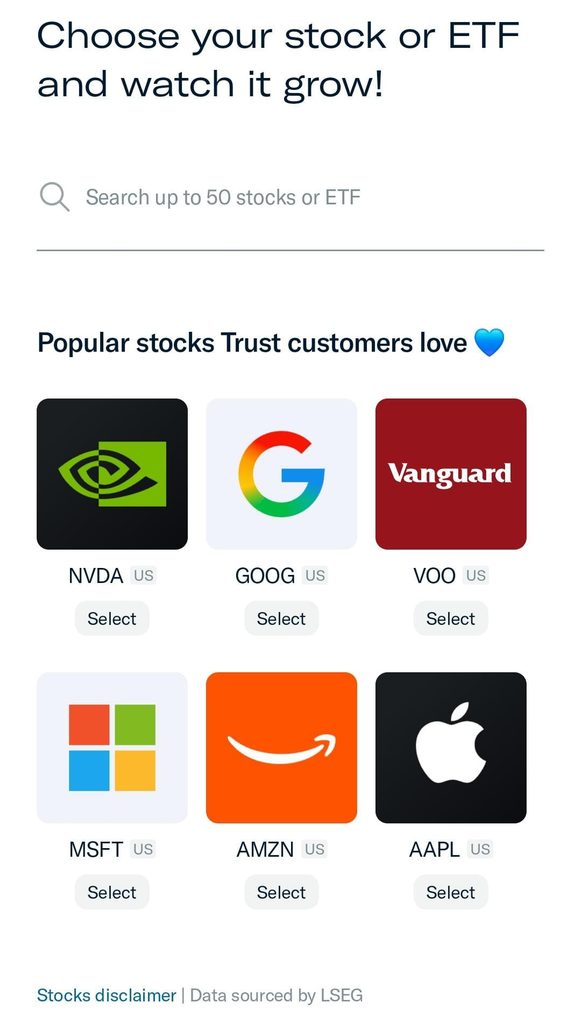
Your Stockback accumulates as you spend. Once you’ve accumulated at least S$10 worth of Stockback, Trust automatically converts it into fractional shares of your chosen investment.
At the current 3% rate, you’d need roughly S$333 of eligible spending to reach that first S$10. My first transaction on the card was for my gym’s PT package, so I could see it in action within the first few days.
There is no need to wait until you can afford an entire share, so you don’t have to worry it’ll take years before you receive your first investment – especially if you choose companies such as Apple or Alphabet which are currently trading at above US$300 per share.
The beauty of this is that the process happens automatically, without the user having to open a brokerage account, transfer cash from their bank into the brokerage, convert from SGD to USD, and then figure out how to navigate the stock pages and set a buy order.
Spend → earn Stockback → accumulate S$10 → Trust invests for you, and you get the (fractional) share.
That’s it.
Why not just earn cashback and invest it yourself?
When one of my friends saw me post on Instagram about using this card, she asked, why not just earn cashback and invest it yourself?
Of course you can. And if you’re someone who manages an investment portfolio the size of mine (or bigger), then the Stockback you earn will hardly be life-changing.
But that’s exactly the point. It was never meant to be for that purpose.
Stockback was never designed for investors to replace their portfolio – it is an add-on, not a substitute. But more importantly, Stockback hits the market at where a gap rests: in this day and age, most people already know they ought to be investing, but not everyone has gotten around to starting – or are being consistent about it.
That’s where I find the Stockback proposition compelling.
How does Stockback compare to other cashback and miles cards?
As a general spending card, I find the flat 3% reward with no minimum spend required is actually pretty compelling. You’d have to weigh your options and decides what’s more attractive to you – a 5% cashback card (with minimum spending and specific spend rules/ limits), or a 1.3 mpd miles card?
There is no way to accurately measure Stockback against the value of a mile or cashback, because the truth is that you’re getting stocks that could go up or down in value.
Choose good stocks, and your reward can end up outperforming any miles or cashback return by a huge margin. Choose a weak stock, and you could see the value of your rewards drop over time.
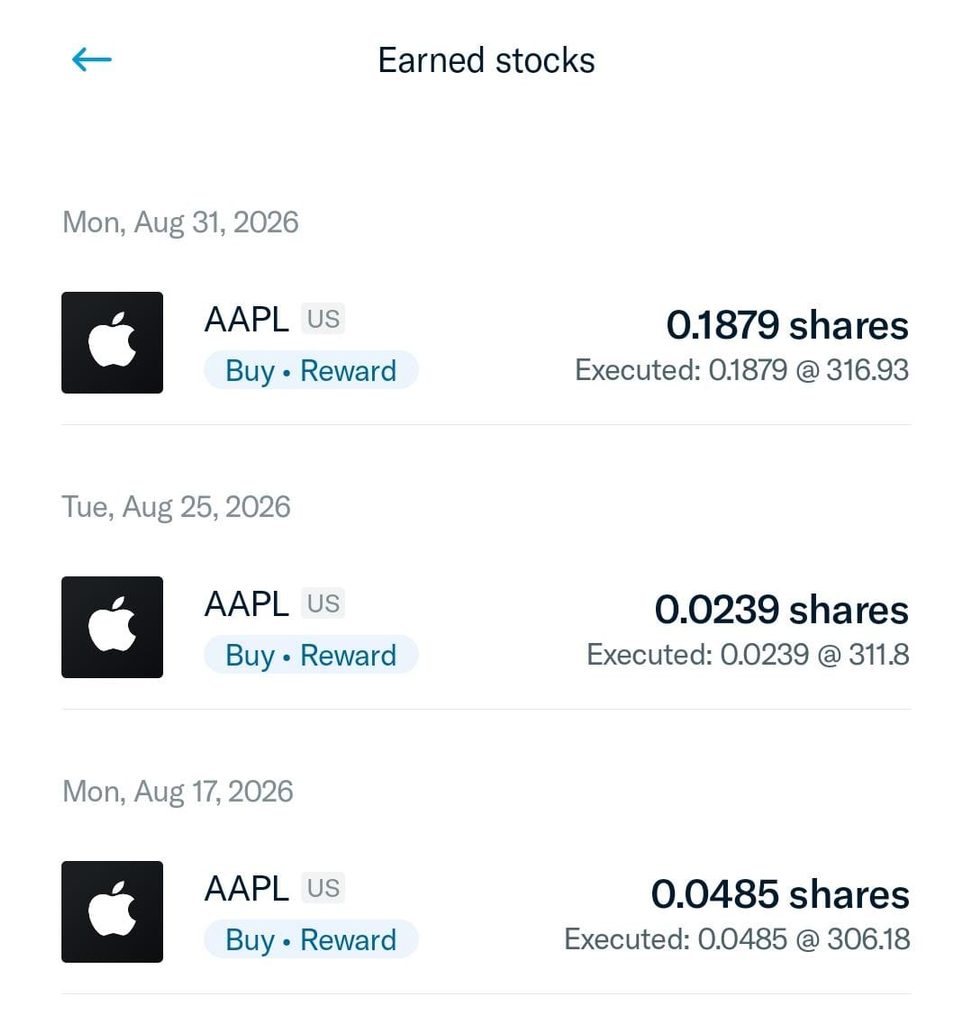
In my case, about USD $81.85 was used to acquire 0.2603 shares of Apple in August. Apple’s share price has risen to US$317.35 at time of publishing, which means my shares are worth about ~S$1 higher now.
You don’t get that with cashback – as cash steadily loses its value to inflation each year. Neither do you get that with miles – which the airlines keep devaluing so you keep needing more miles to redeem that dream flight you set your eyes on 2 years ago.
It’s the behavioural aspect. This works beautifully for all the people who keep procrastinating on investing. Now, instead of receiving S$30 cashback and eventually spending that S$30 on something else, your S$30 becomes an investment before you even have the opportunity to spend it.
The Fees
The absence of the usual platform and custody charges charged by most brokerages makes this much more practical for tiny fractional investments. As Trust Bank partners with Saxo for their investing services, I was half expecting some sort of trading or commission fee incurred. Imagine paying a S$2 commission every time S$10 of Stockback was invested. The concept would fall apart immediately!
Instead, here’s the fees structure:
- Trading commissions for US stocks and ETFs are zero until 31 December 2026, but become 0.05% from 1 January 2027 with a minimum of US$2.99.
- No custody fee, platform fee or settlement fee.
- Applicable third-party regulatory or exchange-related charges (e.g. SEC or FINRA) still apply.
In terms of currency conversion, because Trust is buying US stocks using rewards issued in SGD, there will be a conversion spread incurred. This is fairly nominal and it isn’t worth fussing over when you consider how much (I mean, little) stocks you’re actually getting.
Trust Freedom Card is great for overseas use
The Trust Freedom Card has no foreign transaction fee, as Trust uses Visa’s foreign-exchange rate without adding its own foreign transaction fee.
I’ve personally used my Trust card overseas and found the FX conversion rates extremely competitive — often close to the same-day rates I see on Google:
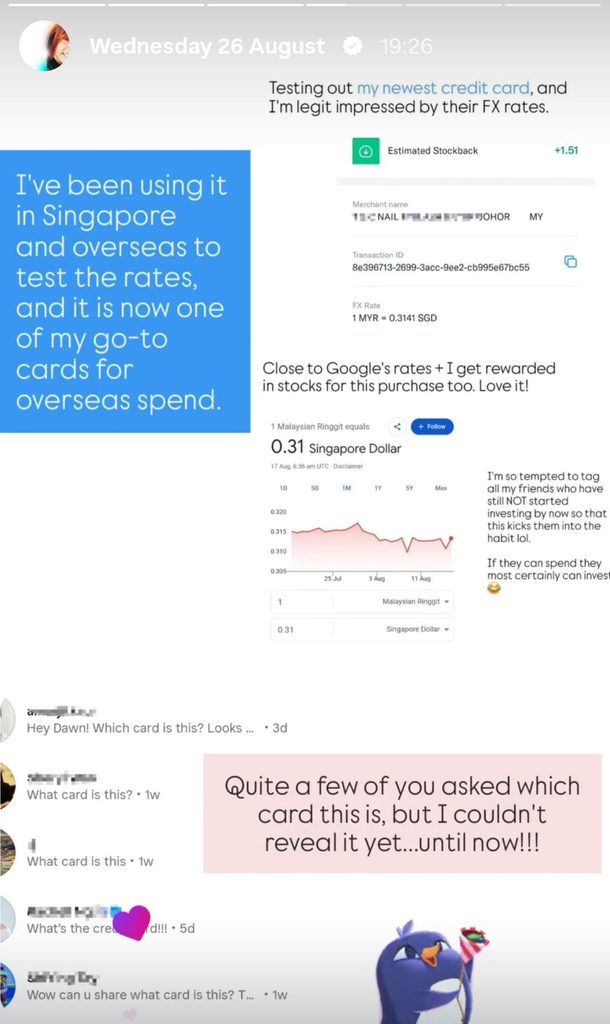
This makes it more compelling than using DBS/HSBC/UOB cards overseas, which charge foreign-currency transaction fees of around 3% (and these bank cards can’t be paired with the amaze card anymore either, which was the previous workaround).
Saving a few percent on FX and then earning rewards on top of your transaction can make a meaningful difference, especially when you’re travelling and spending thousands of dollars. Given that Stockback is capped at S$500 per membership quarter, that means you can technically spend up to S$16,667 and still earn the maximum Stockback reward rate of 3%. In this vein, this makes the Trust Freedom card an easy choice for larger spends that would otherwise bust the caps on other cards.
When NOT to use the Trust Freedom Card
Before you start using your Trust Freedom card for anything and everything, take note that you’d probably want to avoid using it to pay for the following categories of expenses below because they won’t earn you any stockback rewards. These exclusions are pretty common, and I was glad to see that they aren’t too restrictive, but I’ve highlighted the ones in bold that most people might easily miss anyway:
- Cash advances, or any top-ups or payment of funds to any accounts.
- AXS, SAM or ATM transactions made using your Freedom card.
- Insurance premiums.
- Instant Loans or any balance transfers.
- Any monthly instalment of a split purchase transaction.
- Any fees/recurring payments (for example annual card fees, service fees, interest, administrative fees, finance fees, and/or late payment fees).
- Any transaction classified under any of the following Merchant Category Codes:
- Utilities, Rentals and Cleaning Services – 4900, 6513, 7349.
- Financial Institutions, Securities – Brokers, Quasi Cash, Insurance, Stored Value Card Purchase/Load and Wire Transfer – 4829, 5960, 6010, 6011, 6012, 6051, 6211, 6300, 6540.
- Gambling – 7995.
- Educational Institutions – 8211, 8220, 8241, 8244, 8249, 8299.
- Charitable services, political organisations, religious organisations, and government payments – 8398, 8651, 8661, 9211, 9222, 9223, 9311, 9399, 9402, 9405.
- Other services – 7299, 7399, 8999.
Their T&Cs page clearly states that the rewards will only be given for retail spend, with the discretion for Trust to withhold it for any other fees or payments to the list that isn’t already included here.
In my case, I use a different card and service to earn miles on some of the above (excluded) MCCs, so my Trust card won’t be replacing that in my credit card stack anytime soon.
TLDR: is the Trust Freedom Card Stockback worth it?
Let’s be frank, if you’re already investing regularly, then Stockback isn’t going to revolutionise your finances.
But otherwise, 3% on eligible spending with no minimum spend is competitive enough that even experienced investors like me find it worth using for now.
Where I think the card becomes the most interesting, however, is for beginners. Especially that friend who has been telling you for the last 3 years that she knows she needs to invest and she’ll start soon…but then never does.
For folks like these, Stockback creates an almost ridiculously easy entry point. They simply choose an investment and continue living their life, while each time they pay for their coffee, groceries or overseas shopping buys a tiny bit of an ETF.
Over time, those tiny pieces start becoming an actual portfolio. Seeing that portfolio exist might then finally encourage them to start investing intentionally as well.
So for a card that turns someone who has spent years saying “I’ll start investing someday” into someone who finally owns their first investment?
I’d consider that a pretty good start.
My referral code: If you’re new to Trust and would like to sign up, feel free to use my referral code 7CZ382FZ.
Note: This blog post and review is NOT sponsored – I am an actual banking customer with Trust and got the Trust Freedom Card when it launched.


8 comments
Well written article that is clear. But how does one liquidate the US shares?
Hi Elaine, great question. You can sell your rewarded US shares / ETFs directly inside the Trust Bank app using the standard selling process in Trust Invest Stocks. The source I got this from is here: https://trustbank.sg/faqs/credit-card/
P.S. As this is not a sponsored blog article, I did not check with the Trust Bank team to confirm this and am merely relying on publicly released data.
hello. you mentioned that there is commission of 0.05% from 1 January 2027 with a minimum of US$2.99. Does this mean there will be US$2.99 (or 0.05%, whichever is higher) charge for every transaction from 2027 onwards?
Hello, can I check what happen if there’s a loss. Will it go beyond the stockback amount where I have to top up? Say my stockback is $100 the loss is more than that. P.S. Pardon me as I’m a beginner looking into this card too!
Hi thanks for reviewing this card. Could you share more on how much of the 3% stock back went into actual stock and how much went into paying the miscellaneous fee to purchase the stock/etf
Hi KK, no, in the event that the stock you already own (through Stockback) sees its share price go down, you will not have to “top up” for anything. e.g. you own $10 of Apple shares and Apple falls by 10%, that means your Stockback account now has $9 worth of Apple shares instead.
I cannot speak for Trust Bank nor predict what they will do in 2027, but that’s what it currently says on their website T&Cs when I reviewed it in detail! Promotions can always change so I’m watching to see what Trust Bank will announce as 31 Dec draws nearer.
Hello! The “commission & fees” section simply shows zero fees were charged. It doesn’t show details more granular than that, such as the FX fee it was converted at (Stockback is earned in SGD but used to buy US stocks in USD), nor the market depth at the time of the trade settlement where I can check the bid-ask spread. For me, I simply use the formula of 3% stockback earned (SGD), total stocks awarded (in USD) at the moment in time, and % paper gains I’m sitting on now for the stocks that I chose and got.
As an example, I chose Apple in August. My Apple stocks were bought at $306 – $317, whereas Apple sits at $337 now. That’s some gains there already, but it is worth noting that the SGD 10 converted to USD 7.45 on 25 Aug 9.35pm whereas the same SGD 10 would get USD 7.80 now based on Google rates.
So this beats out cashback for me any time, and the purchases I put on my Trust Freedom card in these 2 months were mostly purchases that wouldn’t have gotten me high mileage (min. 4 mpd) on my other credit cards due to spending reward caps or categories restrictions anyway. As mentioned, my approach to credits card is that I’m an OPTIMISER, rather than a MAXIMISER. But from your question, it sounds like you might sit in the latter / might have significant amounts you intend to transact on this card for Stockback, if that’s so then I can imagine why the granular details would actually matter to you. In that case, I’d suggest you may want to email Trust Bank to ask instead if this matters to you in deciding whether to get the card!
Comments are closed.