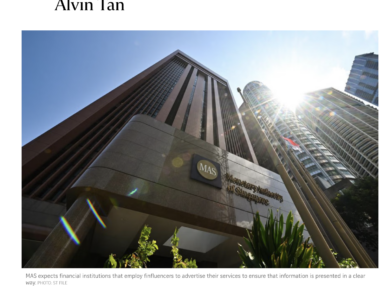
MAS has issued advisory letters to warn 5 content creators on their financial content, and has concurrently released a new set of guidelines for both financial institutions and content creators on how content should be presented moving forward.
I’m penning down my thoughts on this today as
- a finance creator who was involved in the discussions with MAS in the creation of these guidelines
- a creator who was NOT among the 5 who received the MAS’ advisory letter.


As the names of the 5 content creators were not disclosed, the Internet has been rife with speculation on who these might be.
Speculation arises in the absence of truth. Sadly, the state of the Internet also means people can go around making groundless accusations and spreading untruths while hiding behind an anonymous identity, so I am here to debunk some of them.
1. Who are the 5 content creators?
Journalists have reached out to MAS to try and ascertain the identities of the 5, but MAS has declined to name them. While I have no idea who they are as well, here’s some clues:
- They might not all be finfluencers, as what people are speculating.
Let’s not forget that when unlicensed platforms like Octa and XM were heavily promoted in Singapore, it was mostly by lifestyle content creators rather than finfluencers. - Those who were served the letters will likely keep quiet, as denying it publicly will mean making a false statement of fact. One that MAS can debunk anytime if they choose to.
- Those who were not served the letter will be able to tell you that it wasn’t them.
Meanwhile, I can confirm 100% that Budget Babe was not among the 5 creators who received the warning.
Over the years, I’ve also come to learn that many staff in the regulatory bodies are well aware and follow my work closely, so given the visibility of my work (be it on public channels or behind subscription paywalls), I am conscious of the fact that I could be called to “lim kopi” anytime. You can even see my name being called out specifically in front of our Prime Minister here, as he gets questioned on what measures the government is doing when it comes to finance influencers.

Budget Babe has been operating for the last 11 years and has never received a single warning letter from the authorities. I intend to strive to keep it that way.
2. Advertisers can no longer insist that sponsored posts focus only on the benefits and ignore the risks.
My friends in advertising have told me that Budget Babe has a “notorious” reputation as being “difficult” to work with. Yes, it is true that I’m extremely selective about which gigs I take on, and it is also true that I’ve called off deals (even when the draft is already 80% completed and delivered) when the client did not agree to putting the downsides / risks into the post. While having this “reputation” inevitably means I earn a lot less than my finfluencer peers – including lifestyle creators who take on sponsored finance posts – I rather not get paid than to compromise my standards and reputation for money.
In fact, you can see that the first part of MAS’ guide is extremely similar to what I’ve publicly said in my blog since December 2014 here:

This educational process has been the most difficult part of my journey whenever I work with advertisers. It is perfectly understandable – marketers don’t get paid for educating the public about the downsides of their products. Their KPIs are on conversions, actual user sign-ups and consumers putting their money in. It is easier to clickbait when you put a generous benefit headline than to acknowledge that your product is not suitable for everyone because of reasons XYZ.
Which is why I’m glad that MAS has now made it clear that this is the correct way to go.
So if you are a creator who has struggled with these negotiations like I have, you can now use the document to show your clients that it isn’t just you being “difficult”, but that you’re only complying with what MAS has stated.
That’s what I’ll be doing, too.
3. Our regulators do listen.
Before anyone thinks MAS and ASAS simply created this guide out of thin air, let me share some insights on the efforts that were put in. Prior to this was a 6-month period of focus group discussions and several draft iterations before the final version was released yesterday.
3 finance creators were involved in the discussions – The Woke Salaryman, The Financial Coconut and Budget Babe – and we shared about the on-ground realities of organic vs. sponsored finance content, dealing with advertisers, etc. Several changes were made to the guidelines based on our feedback.
One topic that was brought up during the discussions was how much money was offered by XM and Octa to get social media creators to promote the (unclicensed) platform to their followers, and how similar incidents could easily happen again in the future. Thus, while the first draft of the guide called for creators to check that the institution is licensed, this was later changed to include verifying credibility and look into business viability because there is a chance that creators might get approached by overseas brands who may not be licensed in Singapore (yet).
MAS listened, and they made the change. We’re deeply appreciative that they heard our concerns.
4. This MAS guide is only the start.
As more lifestyle creators jump into this space and start taking on finance ads, we will start to see different standards of content being put out. Some might be done by creators who aren’t financially savvy, and are simply reiterating the brief that they were given by the client. Like what PM Lawrence Wong said, buyer beware.
Many people have the impression that there’s a lot of money to be made in brand deals with financial institutions. I’m here to tell you that it isn’t true – lifestyle and travel brands pay more (and are much easier to do). So before you get all green-eyed by the money that top-earning creators show in their videos, it is worth remembering that they are not representative of all of us. For instance, while a YouTuber may have earned $14,000 in a month’s worth of affiliate fees from the same MAS-licensed brokerage that I use and promote, my earnings were only $300 in that same month.
5. Not everything online can be trusted.
In this age of fake news and generative AI, it is getting harder to discern what is real and what isn’t. So as a consumer, we need to understand that no one cares more about your money than you do. Yes, not even the finfluencer who’s passionate about helping you to invest better so that you can retire and not have to worry about running out of money.
This applies to content on online forums too. While these guidelines go into effect next year, there is still none governing financial advice that is being dispensed on forums – and I doubt that we’ll ever see one because it is simply too hard to regulate such spaces.


If you look at what MAS’ guidelines on The Licence Lane states, these fall within recommendations to buy specific investment products and tailoring information to an individual’s circumstances. However, it’ll be hard to regulate here, so you should think twice before acting on any advice given to you by someone you do not know and whom you cannot hold accountable for.
What’s more, I’ve seen plenty of untruths and lies on Reddit, some of which I’ll now debunk:


It gets harder to discern between what’s factual and fake on Reddit. While the platform does have some solid users dishing out sound advice, it is also full of keyboard warriors and anonymous attackers who spread untruths without repercussions. Hence, the best way to use online discussion forums like these would be to become financially savvier yourself to discern between what’s a good or bad recommendation, and then make the right decisions that will benefit your own situation. In the absence of regulatory guidelines for forum users (remember HWZ and EDMW in the pre-Reddit era?), the onus is on us to protect our own interests and financial well-being.
Final thoughts: It will become harder for creators to produce finance content online.
As the regulators increase their oversight on finance content online, I think this is a welcome move. Creators who simply put out low-quality content and pander to their advertisers’ demands without putting their followers’ well-being first will eventually lose their credibility and footing in the scene, whereas creators who strike a good balance will continue to stick around and thrive for the long-run.
But at the end of the day – regulatory guidelines or not – I still feel that the real solution is for consumers to become financially savvier and learn how to manage our money. That’s because ultimately, no one cares more than we do.
Only by becoming savvier can you then better discern between what is a piece of misleading advice and something that you can actually implement to benefit your personal situation.
After all, just like how many of you read my content, I too, consume finance content from several local creators – including Dr Wealth, The Fifth Person, The Woke Salaryman, The Financial Coconut and more. I also subscribe to overseas premium content platforms such as Moby and The Motley Fool, even if I don’t always agree with their insights or stock recommendations, never once have I seen it as “advice” because they are simply content and research reports.
I curate who to I choose who to follow based on their credibility and by assessing the content that they put out. And over the years, I’ve similarly stopped following several creators because I repeatedly disagreed with their content, such as echoing generic motherhood statements like “just DCA and buy the S&P500 is good enough”.
You can read my thoughts here and here on why I disagree with such motherhood statements – I believe outperformance is achieved by buying into undervalued ETFs and multi-bagger stocks when price falls due to depressed sentiment, and not by simply doing what is easy and convenient. Historical performance is never a guarantee for future returns, but this is something that only time can tell who’s right and who’s wrong.
Whether I agree or disagree, one thing has remained constant: I never make my decisions in isolation just based on a piece of content from that creator, because I know that none of them can ultimately be responsible for my investing or financial outcomes.
That responsibility is 100% on me, myself and I.
The same applies to all of us.
With love,
Dawn